
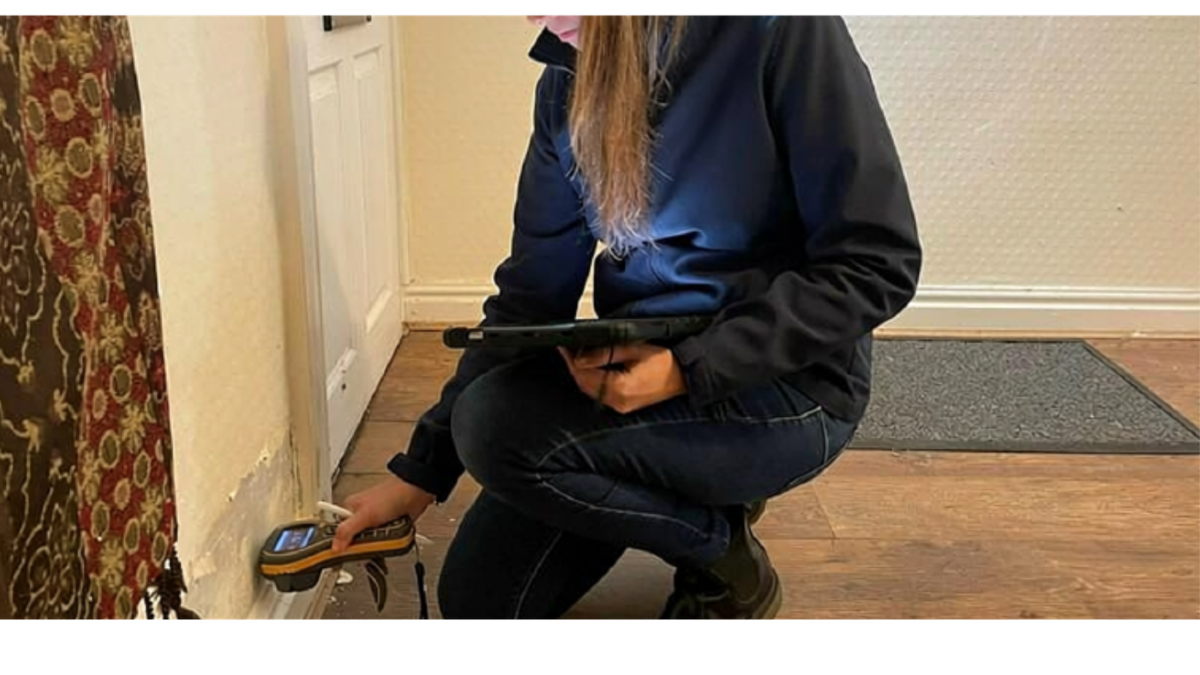
From October, Scottish landlords will face firm deadlines for investigating damp and mould and starting repairs. England hasn’t yet imposed the same rules on private landlords — but Awaab’s Law is coming to the PRS. I think there are some useful clues here about how landlords should prepare.
In this article
- What Scotland’s new damp and mould deadlines require
- Where Awaab’s Law currently applies in England
- What Scotland might tell us about the direction of travel
- Why “tenant lifestyle” isn’t a sufficient diagnosis
- Why proper damp and mould assessment matters
- What Leicester landlords should be doing now
From 6 October 2026, new rules covering private and social rented homes in Scotland require landlords, once notified of damp or mould, to:
- investigate the report within 10 working days;
- provide a written summary within 3 working days of completing the investigation; and
- commence necessary repairs within 5 working days of the investigation. Scottish Government
For landlords in Leicester, you could reasonably ask: so what? Housing law in Scotland is different from housing law in England. These aren’t our rules.
Quite true, of course. But what’s interesting is the process they create:
Report → investigate → record → decide what action is needed → start the work.
Each stage creates evidence of what happened and when.
Awaab’s Law is coming to private landlords
Awaab’s Law already applies to England’s social rented sector, where legally enforceable timescales now apply to significant damp and mould hazards and emergency hazards.
Private landlords aren’t yet subject to those same timescales. However, the Renters’ Rights Act 2025 provides for Awaab’s Law to be extended to privately rented homes. The precise requirements and implementation timetable are still to be settled.
So, although Scotland’s deadlines aren’t about to become English law, they tell us about the direction of travel. Legislation.gov.uk
The issue we landlords know is that damp and mould isn’t always straightforward
A patch of mould tells you there’s a problem. It doesn’t tell you what’s causing it.
There may be a leak, penetrating damp, insufficient ventilation, inadequate insulation or a cold bridge. How the property is being occupied can also contribute — inadequate heating, drying clothes indoors, covered vents or furniture against cold external walls can all create conditions in which condensation and mould develop. Often several factors interact.
So landlords are now required to understand that you can’t start with the conclusion that “it’s the tenant’s lifestyle” and work backwards from there (or even just ignore it on the same grounds). Awaab’s Law guidance for landlords
The better approach is to investigate the possible causes and progressively rule them in or out.
If a competent assessment ultimately concludes that occupation is the principal cause, that’s considerably more useful to a landlord than simply beginning with that assumption.
Help for landlords to properly understand mould in their properties
Our Director, Gosia Prazeniak, is a qualified Mould Assessor.
That isn’t because we suddenly fancied adding another certificate to the office wall.
It reflects where we think property management is going.
If a landlord receives a report of damp or mould, the important questions aren’t simply:
Did somebody go round and look at it?…or…Did somebody wipe it down?
The questions landlords need to be able to answer are: What was reported? When? What did you find? What was the likely cause? Was there a risk to the occupants? What did you decide needed doing? When did you do it? And where is the record?
Not sure what’s causing damp or mould in your property?
A proper assessment can help establish the likely cause, what needs doing and provide a clear record of what was found.
Scotland has now effectively written that discipline into a timetable, and this is immensely useful for landlords in England, indeed in Leicester.
So should Leicester landlords start working to Scotland’s deadlines?
No. A Leicester private landlord does not suddenly have a statutory ten-working-day statutory deadline because Scotland has introduced one.
But, to be perfectly honest, we think it possible that the new rules for England could be even tighter.
So, would your present process cope if something similar were introduced here?
Suppose a tenant emailed you this afternoon with photographs of significant mould in a bedroom. Here’s your checklist:
- would you know exactly when it was reported?
- could you assess its seriousness?
- could you arrange a competent inspection?
- would the findings be recorded?
- could you establish the underlying cause rather than simply remove the visible mould?
- could you demonstrate afterwards what you did and when?
If the answer is “probably, but it’s all a bit informal”, that’s where I think the warning from Scotland becomes useful.
Don’t wait for the stopwatch
We don’t yet know what the final English private rented sector version of Awaab’s Law will require. But we do know the direction of travel.
Damp and mould is increasingly being treated not merely as an unfortunate property defect but as a potential health hazard requiring investigation, action and evidence.
Scotland has now put a clock around that process. I wouldn’t wait for England to tell me exactly how many days I’ve got. I’d make sure I could already answer one much simpler question:
“A tenant reported a potentially serious problem. Can I show that I dealt with it properly?”
That feels to me like essential property management whatever the eventual regulations say.
Sometimes a second pair of experienced eyes helps.
With so many rules, responsibilities and practical issues to keep on top of, bring us whatever’s concerning you and we’ll talk it through with you at our Leicester Rental Clinic.
Bring the questions. We’ll help you work through the answers.